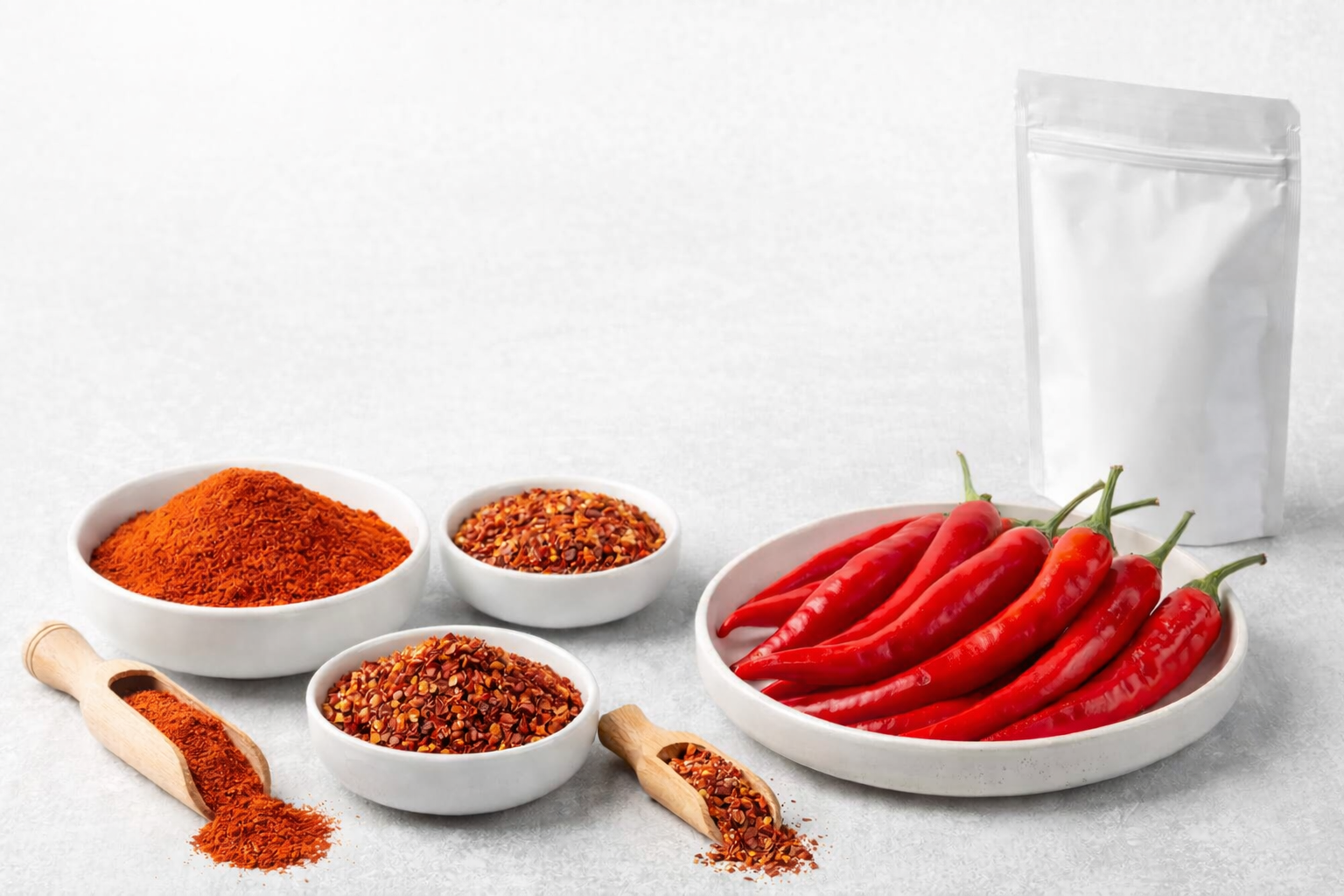
Understand major Chinese chili powder types, key origins, cultivar-driven flavor differences, and how to specify
heat (SHU), color (ASTA), and mesh size. Includes why
Zunyi (Guizhou) is a strong choice for consistent, export-ready supply—and how we support
customized OEM production.
(2) processing method (sun/air-dried, roasted, smoked), (3) particle size (mesh), and (4) performance specs
(SHU heat + ASTA color + moisture + cleanliness). For global buyers seeking stable supply and a distinctive
aromatic profile, Zunyi (Guizhou) origin is widely recognized for its suitability in
industrial and food-service formulations.
1) Major Types of Chinese Chili Powder
A. By formulation: Pure vs. Blended
Pure Chili Powder (Single Ingredient)
100% ground dried chili. Ideal for manufacturers and food-service chains that need a controllable base
ingredient for sauces, seasonings, hotpot soup bases, snack powders, and compound blends.
- Best for: standardized recipes, stable procurement, quality control.
- Common specs: SHU range, ASTA/color, mesh, moisture, foreign matter limits.
Blended Seasoning Chili Powder
Chili powder combined with salt/sugar/garlic/cumin/pepper and other spices for ready-to-use flavor systems.
Suitable for BBQ rubs, table seasonings, marinades, and snack flavoring.
- Best for: fast application and consistent taste.
- Common add-ons: cumin & garlic profiles, smoky notes, regional blends.
B. By processing: Dried / Roasted / Smoked
- Standard dried chili powder: clean aroma, stable performance for export and industrial use.
- Roasted chili powder: deeper “toasted” aroma and stronger savory impact (popular in BBQ and dipping mixes).
- Smoked chili powder: natural smoky character for BBQ, cured meats, sauces, and premium rubs.
C. By particle size: Mesh matters
- Coarse granules: visible flakes and mouthfeel for sprinkles/toppings.
- Medium: balanced dispersion, common for blends.
- Fine powder: best for sauces, soups, instant seasonings, and uniform mixing in dry systems.
2) China’s Key Chili-Producing Regions & Flavor Differences
China produces chili across multiple climate zones, and each region tends to favor different cultivars and
processing habits. For global buyers, think of origin as a practical indicator of
aroma style, heat expression, and batch stability.
| Region (Examples) | Typical Buyer-Relevant Characteristics | Common Applications |
|---|---|---|
| Southwest China (Guizhou, Sichuan, Yunnan) | Often prized for aromatic complexity and bright appearance; strong suitability for processed food supply chains when standardized. | Hotpot bases, sauces, compound seasonings, food-service. |
| Central China (Hunan, Hubei) | Known for punchy heat and spicy-forward profiles; frequently used in restaurant-style seasonings and bold blends. | Restaurant blends, spicy sauces, ready-to-use seasonings. |
| North / Plains (Henan, Shandong, etc.) | Large-scale dry chili supply in many cases; product profiles depend heavily on cultivar and processing. | Industrial formulations, blended powders, snack seasoning. |
| Northwest (select areas) | Drier climates can support certain drying efficiencies; profiles vary by cultivar and local processing. | Powder, flakes, and blends depending on cultivar. |
always combine origin with measurable specs: SHU, ASTA/color, mesh,
moisture, and cleanliness/micro limits.
3) Why Zunyi (Guizhou) Origin Chili Powder Is a Competitive Choice
Zunyi, located in Guizhou Province (Southwest China), is widely recognized as one of China’s best-known
chili-growing and trading hubs. For overseas buyers, Zunyi origin is especially compelling for three practical
reasons:
1) Distinct Aroma & Appealing Red Appearance
Zunyi-origin raw materials are often valued for a naturally aromatic profile and a bright, appetizing red
tone—useful for products where aroma and visual “redness” drive consumer perception.
2) Mature Industry Cluster (Stable Sourcing)
A developed regional supply chain supports steady procurement, standardized processing, and predictable
delivery schedules—key for manufacturers and food-service brands.
3) Better Standardization for Export-Oriented Requirements
When paired with batch testing and controlled processing, Zunyi-origin chili powder can be supplied with
consistent SHU/ASTA/mesh targets and documentation suitable for international trade workflows.
Best Fit Use-Cases
- Hotpot soup bases, sauces, and spice blends
- Snack seasoning systems
- BBQ rubs (including roasted or smoked styles)
- Industrial formulations requiring stable color & heat
4) How to Specify Chili Powder Like a Professional Buyer (RFQ Checklist)
If you want fewer sampling rounds and faster quoting, include these items in your RFQ. This also helps prevent
“same name, different performance” issues across suppliers.
| Specification | Why It Matters | Typical Options (Customizable) |
|---|---|---|
| Heat (SHU) | Controls perceived spiciness; critical for recipe consistency. | Target range with tolerance (e.g., low / medium / high; exact SHU range upon request). |
| Color (ASTA / color value) | Determines red intensity and visual appeal in finished foods. | Color target with acceptable band (ASTA range as required). |
| Particle size (Mesh) | Affects dispersion, mouthfeel, and blending uniformity. | Coarse / medium / fine; mesh range matched to your application. |
| Moisture | Impacts shelf stability, flowability, and caking risk. | Moisture target (upper limits available per requirement). |
| Cleanliness & foreign matter | Quality and compliance; reduces downstream production risk. | Defined limits and inspection protocols. |
| Micro / safety limits | Required for export compliance and food safety assurance. | Limits aligned with your target market and product category. |
| Packaging | Protection, handling efficiency, and labeling needs. | Bulk bags, inner liners, private label packs (by request). |
| Application | Ensures aroma, heat, and texture match your end-use. | Hotpot / sauce / snack / BBQ / seasoning blend, etc. |
Note: Exact ranges, documentation, and compliance requirements should be aligned to your destination market and
product category. We can recommend a target spec set after you share your application.
5) Our Zunyi-Origin Chili Powder Advantage & Custom Manufacturing Capability
We focus on supplying high-quality chili powder based on Zunyi (Guizhou) origin,
with an emphasis on stable batch performance and customized production for overseas
customers.
Quality Focus
- Origin-based raw material selection (Zunyi, Guizhou)
- Process controls for consistent aroma, heat, and color
- Batch documentation support (e.g., COA/TDS upon request)
Customization (OEM / Private Label)
- Heat (SHU) targeting
- ASTA/color target matching
- Mesh size / granulation options
- Roasted or smoked profiles (when needed)
- Custom blends for BBQ, hotpot, snack seasoning, sauces
- Packaging formats to fit your supply chain
Send your application + target specs (SHU/ASTA/mesh/moisture) + expected annual volume. We will propose a
matching Zunyi-origin solution and sampling plan.
Request Samples / COA / Pricing
and your desired taste profile (aromatic, smoky, mild/medium/hot). We will translate that into measurable specs.
FAQ
What is the difference between pure chili powder and blended seasoning chili powder?
Pure chili powder is 100% ground chili and is ideal as a controllable base ingredient. Blended seasoning chili
powder includes additional spices (salt, garlic, cumin, etc.) to deliver a ready-to-use flavor profile.
How do I choose the right heat level for my product?
Start with your target consumer heat perception and serving format. Then define a SHU range with tolerance.
For food manufacturing, specifying SHU helps ensure batch-to-batch consistency across production runs.
Why is ASTA/color value important?
ASTA/color value is a common way to describe red color intensity. It affects the visual “redness” of sauces,
soups, seasonings, and snack powders, and can be as important as heat for consumer acceptance.
Can you match mesh size for my mixing or dispersion needs?
Yes. Coarser particles work well for toppings and visible texture, while fine powders disperse better in sauces,
soups, and dry seasoning systems. We can recommend mesh targets based on your application.
Do you support OEM/private label?
Yes. We support customized specifications and packaging solutions, including OEM/private label projects. Share
your target market, labeling needs, and compliance requirements, and we will align production accordingly.