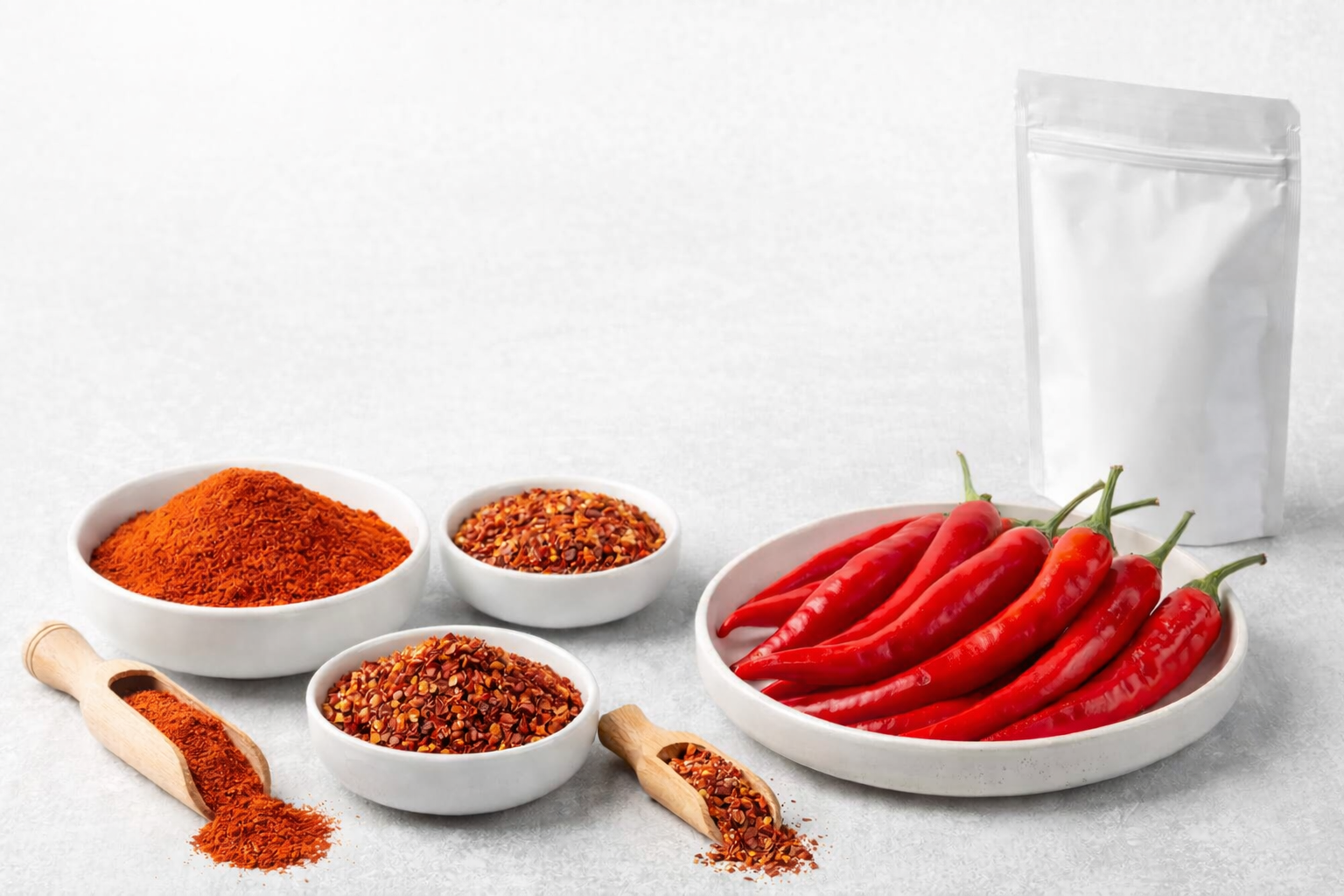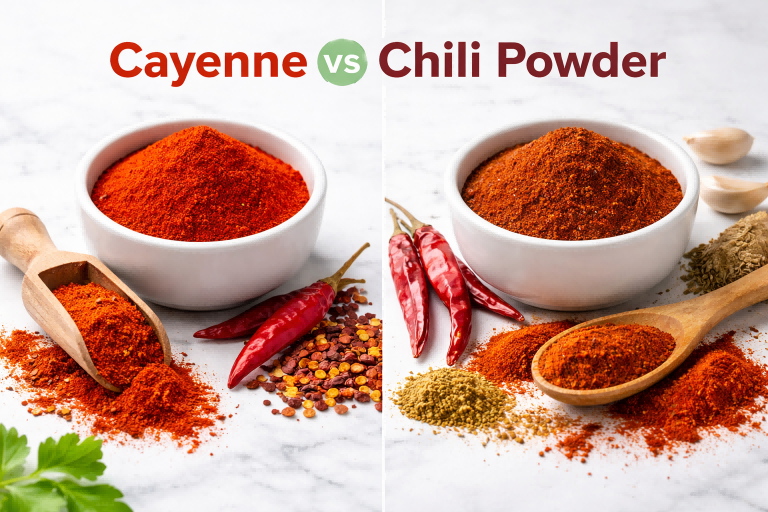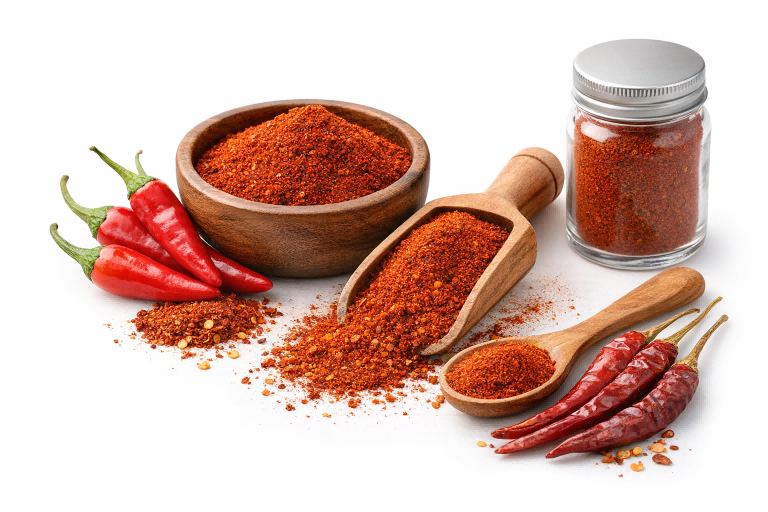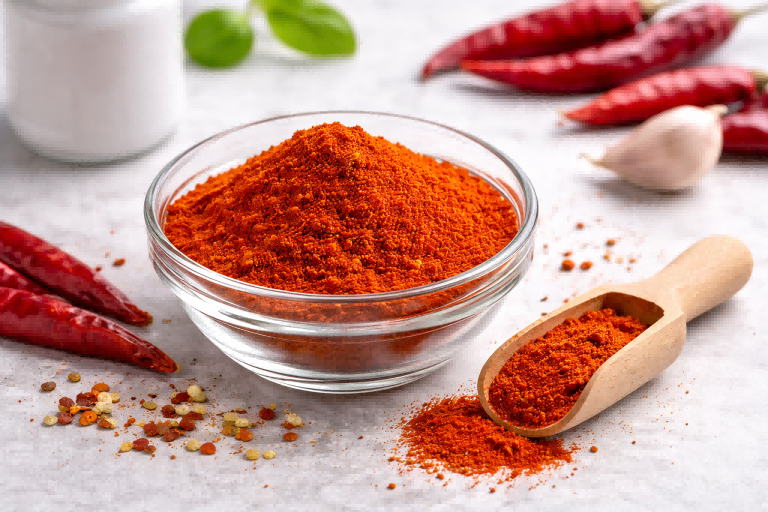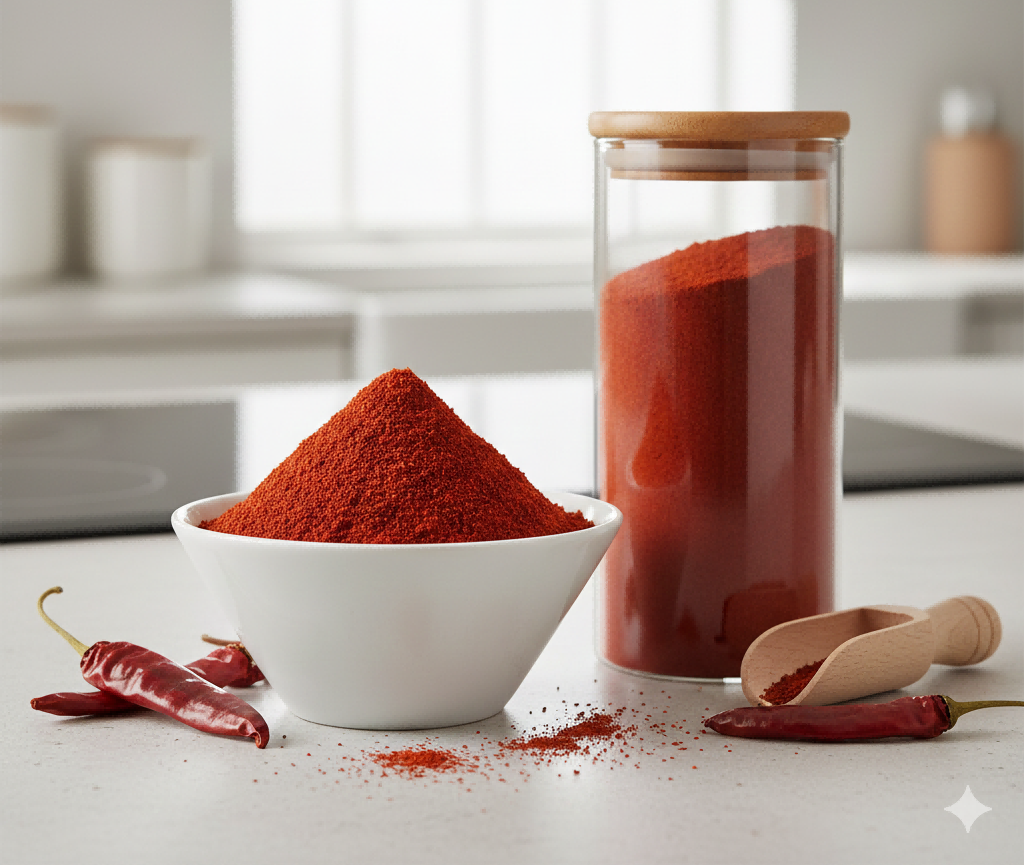
Chili powder looks simple on the surface, but behind every kilogram of stable, vibrant, food-safe powder there is a carefully engineered industrial production process.
For B2B users—food manufacturers, sauce processors, hotpot brands, snack factories, and central kitchens—the way chili powder is produced is directly linked to:
- Consistent SHU heat level and ASTA color value.
- Microbiological safety and shelf-life.
- Batch-to-batch stability for large-scale production.
- Formulation efficiency and cost control.
This article explains the complete chili powder manufacturing process from a B2B perspective: how chilies move from field to factory, through cleaning, drying, grinding, blending, sterilization, packaging, and quality control. It also links process understanding to sourcing and supplier evaluation, with deeper resources here:
1. Why the Chili Powder Production Process Matters for B2B
For retail consumers, chili powder is “red and spicy.”
For B2B users, it is a functional processed ingredient whose performance is defined by how it is made.
Key ways the production process shapes chili powder performance:
- Color development and stability: Drying temperature, exposure to oxygen, and packaging choices influence ASTA color over time.
- Heat expression and uniformity: Blending, grinding, and mixing systems decide how evenly SHU is distributed in every kilogram.
- Aroma release: Process parameters determine whether aroma compounds survive drying, grinding, and storage.
- Microbiological profile: Cleaning, moisture control, and sterilization steps decide if chili powder can safely be used in ready-to-eat or minimally cooked products.
- Cost and consistency: A well-designed process supports stable quality with predictable cost structures across multiple seasons and origins.
If a factory’s process is weak, even good raw material can end up in:
- Unstable color between batches.
- Heat that is either too weak or unexpectedly strong.
- Off-notes such as burnt, musty, or oxidized flavors.
- Microbiological failures and product recalls.
For buyers, understanding the core steps of chili powder manufacturing is the basis for meaningful technical discussions with suppliers and for evaluating who can support long-term projects.
2. From Fresh Chili to Finished Powder: High-Level Process Overview
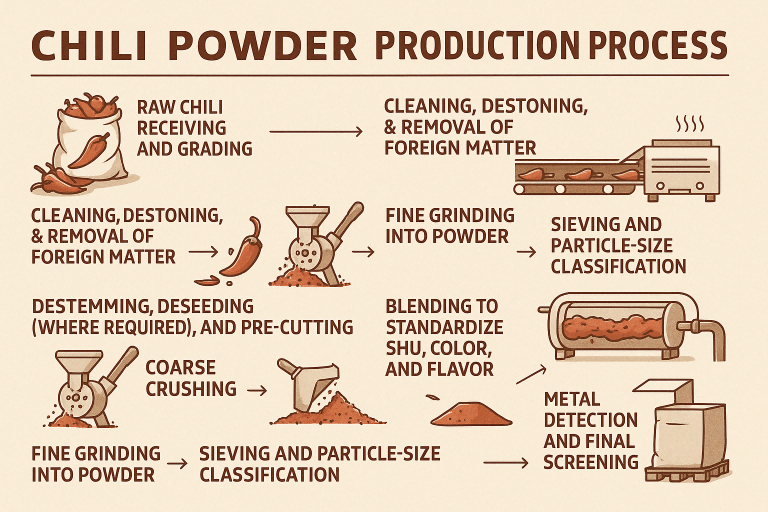
At an industrial level, the chili powder production process is designed as a series of controlled stages with critical control points (CCPs). A simplified high-level flow looks like this:
- Raw chili receiving and grading.
- Cleaning, destoning, and removal of foreign matter.
- Initial or final drying to target moisture.
- Destemming, deseeding (where required), and pre-cutting.
- Coarse crushing.
- Fine grinding into powder.
- Sieving and particle-size classification.
- Blending to standardize SHU, color, and flavor.
- Sterilization (e.g., steam treatment).
- Metal detection and final screening.
- Packaging and palletization.
- Finished product quality testing and release.
How each of these stages is implemented—the equipment chosen, the parameters used, and the hygiene controls applied—creates the difference between ordinary chili powder and a stable, export-ready industrial ingredient.
3. Raw Material Preparation and Pre-Processing
Even though this article focuses on production process, the starting point is still how the fresh chili enters the line.
3.1 Receiving and Visual Pre-Screening
When truckloads of dried or semi-dried chili arrive at the factory, the first step is:
- Checking documentation (origin, lot numbers, harvest time).
- Visual pre-screening for mold, rot, insect damage, and severe discoloration.
- Sampling for quick checks on moisture, color, basic contaminants.
Lots that clearly fail basic standards (visible mold, serious infestation) should be rejected before entering the process flow.
3.2 Mechanical Cleaning and Foreign Matter Removal
Industrial chili powder production typically uses a combination of:
- Vibratory sieves: Remove larger physical impurities such as stones, sticks, clumps of soil.
- Air classifiers / aspiration channels: Remove lighter impurities such as dust, leaves, and broken stems.
- Magnetic separators: Capture ferrous metals from field tools, harvest machinery, or previous processing steps.
Good pre-cleaning reduces:
- Grinding equipment wear and damage.
- Physical hazard risks for end customers.
- Downstream contamination issues.
3.3 Optional Washing
Some factories incorporate washing systems for certain product lines, especially when local raw material is heavily contaminated with soil. This requires:
- Careful re-drying later to restore safe moisture levels.
- Hygienic design of washing and draining systems.
Not all chili powder is washed; many industrial B2B products rely on dry cleaning plus strict drying and sterilization instead.
4. Drying Technologies and Moisture Control
Drying is one of the most critical process steps. It influences color, aroma, micro stability, and grinding performance.
4.1 Drying Objectives
Industrial chili drying aims to:
- Reduce moisture to a safe range (often 8–12%).
- Prevent microbial growth and insect activity.
- Prepare chili for efficient grinding (not too hard, not too rubbery).
- Preserve pigments and volatile aroma compounds as much as technically possible.
4.2 Common Drying Methods
Typical systems in industrial chili powder plants include:
- Sun/yard drying (at origin): Low-cost, but weather-dependent and less controllable. Needs careful handling to avoid contamination.
- Batch hot-air ovens: Flexible and suitable for smaller volumes or specialty products.
- Continuous belt or tunnel dryers: Better for large-scale operations, enable more stable control of temperature and airflow.
4.3 Temperature, Time, and Quality Trade-Offs
Process engineers must balance:
- Higher temperature: Faster drying but risk of pigment breakdown, browning, and cooked/burnt notes.
- Lower temperature: Better color and aroma retention but requires more time and energy.
A well-designed curve often uses moderate temperatures with staged airflows to protect quality while achieving target moisture efficiently.
4.4 Moisture Testing and In-Line Controls
To avoid under-drying (microbial risk) and over-drying (powder becomes too brittle, loss of yield), factories use:
- In-line or batch moisture measurements.
- Representative sampling per lot and per drying batch.
- Standard operating procedures (SOPs) linking measured moisture to process adjustments.
5. Destemming, Deseeding, and Size Reduction Before Grinding
Before moving to fine grinding, many factories perform an intermediate stage to optimize product quality and equipment performance.
5.1 Destemming and Deseeding
Stems and seeds have different roles:
- Stems: Mostly unwanted fiber; they contribute little color or aroma and can appear as sharp foreign matter.
- Seeds: Provide some heat and texture but can dilute color and increase fiber content.
Depending on the product:
- High-color powders may remove a larger proportion of seeds to concentrate pigments.
- Flake products might keep more seeds for visual effect, depending on the target market.
Mechanical destemming and deseeding systems help standardize the seed-to-skin ratio, which directly affects color, mouthfeel, and extraction behavior in oil.
5.2 Pre-Cutting / Flaking
Large, whole dried chilies are usually:
- Cut into smaller strips or pieces.
- Crushed into flakes or granules.
This pre-cutting step:
- Makes feeding into grinders smoother and more controllable.
- Reduces sudden load peaks on grinding equipment.
- Allows early separation of overly hard or foreign bodies.
6. Grinding, Particle-Size Engineering, and Powder Types
Grinding is often seen as the “core” of chili powder production, but in reality, it only works well when upstream conditions are right.
6.1 Types of Grinding Equipment
Factories may use:
- Hammer mills: Common for general-purpose chili powder; robust and relatively simple.
- Pin mills: Provide finer particle-size distributions and can be adjusted for different mesh sizes.
- Roller mills or disc mills: Sometimes used for specific textures or flake products.
Choice of equipment is driven by:
- Target fineness (e.g., 20–40 mesh for coarse powder, 60–120 mesh for fine powder).
- Capacity and energy efficiency requirements.
- Heat sensitivity of the specific chili variety.
6.2 Heat Management During Grinding
Grinding generates frictional heat, which can:
- Damage pigments (color darkening or fading).
- Drive off volatile aroma compounds.
- Accelerate oxidation if powder is exposed to air while hot.
Good practice includes:
- Controlling feed rate to avoid overloading the mill.
- Using equipment with good heat dissipation or cooled air where needed.
- Minimizing residence time of powder in hot zones.
6.3 Sieving and Particle-Size Classification
After grinding, chili powder is passed through sieving systems to:
- Remove oversized particles (returned to grinding).
- Separate into different fractions (e.g., flakes, coarse powder, fine powder).
- Ensure conformity to customer specifications (mesh size distribution).
Particle-size uniformity is critical in:
- Snack seasonings, where powder must adhere evenly to product surfaces.
- Sauce and paste production, where mouthfeel and dispersion matter.
- Dry blends, where segregation of large and small particles can cause formula inconsistency.
7. Blending, SHU/ASTA Control, and Process Standardization
Once different grind fractions and lots are available, the factory moves to “engineering” the final product.
7.1 Why Blending Is Essential
Because chili is an agricultural product, no two lots are exactly the same. Blending allows the factory to:
- Average out variations in SHU and ASTA.
- Combine different origins and varieties for flavor and risk management.
- Customize chili powder for specific customers and applications.
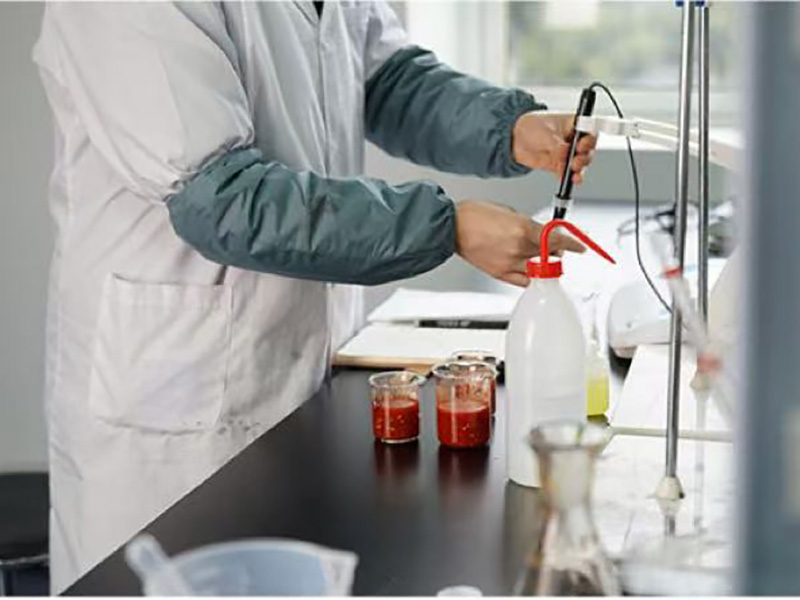
7.2 Lab Testing to Define Blend Ratios
Before blending at scale, laboratory tests help define:
- SHU (heat level) of each lot.
- ASTA color for each component.
- Basic flavor and aroma profile (via sensory checks).
Blending formulas are then calculated to hit target specifications—e.g., “30,000–40,000 SHU, ASTA ≥ 130, 40–60 mesh”—with acceptable tolerances.
7.3 Batch vs Continuous Blending
Depending on scale, factories may use:
- Batch ribbon blenders or paddle mixers: Flexible for multiple SKUs and custom blends.
- Continuous mixing systems: Suitable for very high-throughput, standardized products.
Verification samples from blended batches are sent to QC before the product is approved for sterilization and packing.
8. Sterilization, Food Safety, and Regulatory Requirements
For many export and high-risk applications, sterility and low micro counts are non-negotiable.
8.1 Microbiological Risks in Chili Powder
Without proper control, chili powder may carry:
- High total plate counts.
- Yeast and mold (linked to high moisture or poor drying).
- Pathogens such as Salmonella in severe contamination cases.
These risks are especially critical when chili powder is used in:
- Ready-to-eat products.
- Seasonings applied post-baking or post-frying.
- Cold sauces or dressings.
8.2 Steam Sterilization and Alternative Technologies
A common industrial solution is steam sterilization, which:
- Uses controlled steam and temperature profiles.
- Reduces microbial counts to compliant levels.
- Minimizes quality damage when parameters are optimized.
Alternatives or complementary approaches may include:
- Dry heat treatments.
- Validated kill steps built into process (for example, integrated thermal processes in downstream products).
8.3 Regulatory and Documentation Requirements
Export-oriented factories normally support buyers with:
- Certificates of Analysis (COA) per batch.
- Statements on compliance with local and international regulations.
- Details of sterilization parameters or validation reports, where appropriate.
For more information on how process and compliance fit into supplier evaluation, see the Chili Powder Supplier Industry Guide.
9. Packaging, Storage, and Logistics in the Supply Chain
After the chili powder has been ground, blended, and sterilized, how it is packed and handled will decide how much of that quality reaches the end user.
9.1 Packaging Formats
Common industrial formats include:
- Multi-layer kraft paper bags with inner PE liners (20–25 kg): Standard for B2B bulk supply.
- Smaller bags or pouches (e.g. 500 g–5 kg): For foodservice, smaller factories, or pilot plants.
- High-barrier bags, sometimes nitrogen-flushed: Used for particularly sensitive or high-value products.
9.2 Packaging as a Process Step
Packaging is not “just a container” – it is part of the process:
- Filling equipment should minimize dust and oxygen exposure.
- Sealing must be strong enough to prevent moisture ingress during transport.
- Labels must carry batch numbers and production dates for full traceability.
9.3 Storage and Shipping Conditions
Best practice storage for chili powder:
- Cool, dry, well-ventilated warehouses.
- Avoid direct sunlight, heat sources, and high humidity.
- Segregation from strong-smelling materials (chemicals, perfumes, certain spices).
For long-distance shipping, especially in hot climates, buyers and suppliers sometimes agree on:
- Using insulated or temperature-managed containers when necessary.
- Shorter shipment cycles or controlled pipeline stocks for color-critical projects.
10. Quality Control Systems Along the Production Line
A robust process is supported by a robust QC system covering raw materials, in-process checks, and finished goods.
10.1 Raw Material QC
Key tests may include:
- Moisture content.
- Visual and organoleptic assessment (color, defects, aroma).
- Basic microbial and contaminant checks, depending on risk profile.
10.2 In-Process Control Points
During production, experienced factories track:
- Moisture after drying.
- Particle-size distribution after grinding and sieving.
- Equipment cleanliness and allergen control where needed.
- Consistency of blending (homogeneity testing for selected batches).
10.3 Finished Product Testing
For each batch of finished chili powder, typical QC data may include:
- Moisture.
- ASTA color value.
- SHU heat level (for defined products).
- Mesh size or particle-size profile.
- Microbiological results.
- Heavy metals, pesticide residues, and mycotoxins where required.
Buyers can request COAs and, for long-term projects, may align on specific test items and frequencies.
11. Common Process Risks and Questions Buyers Should Ask
Understanding typical process risks helps buyers ask better questions and choose factories with real control.
11.1 Process-Related Risks
- Overheated drying or grinding: Dark color, burnt notes, reduced aroma.
- Under-controlled moisture: Caking, mold risk, reduced shelf-life.
- Inadequate cleaning: Stones, metal, stems, and other foreign matter.
- Weak blending control: Unstable SHU and color between batches.
- Insufficient sterilization: Micro failures, especially for export markets.
11.2 Key Questions to Ask Potential Suppliers
When discussing with a chili powder manufacturer, B2B buyers can ask:
- Which drying systems do you use? How do you control temperature and moisture?
- What type of grinding equipment do you operate, and how do you manage heat?
- How do you standardize SHU and ASTA between harvest seasons?
- Do you have steam sterilization or another validated kill step?
- Can you share sample COAs including micro, SHU, and ASTA for typical products?
- What is your traceability system from raw material to finished goods?
For a more systematic view of supplier evaluation, again see the Chili Powder Supplier Industry Guide.
12. From Production Process to Sourcing Strategy
Understanding the production process is not only about technical curiosity—it is a strategic tool for sourcing and product development.
12.1 Matching Process Capabilities to Application Needs
Different applications (hotpot base, snack seasonings, RTD sauces, frozen meals) have different sensitivity to:
- Color stability.
- Heat profile and uniformity.
- Aroma retention after processing.
- Micro requirements and sterilization needs.
Mapping your application’s priorities onto the supplier’s process capabilities helps you:
- Define realistic, meaningful specifications.
- Choose the right product grade and processing route.
- Decide whether you need steam-sterilized, high-ASTA, or special mesh-size chili powder.
12.2 Integrating Origin and Process Thinking
Origin (climate, soil, altitude) and process (drying, grinding, blending) interact. For example:
- High-aroma, high-color origins such as regions in Guizhou can be paired with low-temperature drying and careful grinding to create premium chili powder for flavor-critical applications.
- More cost-sensitive origins might be blended and processed to reach acceptable but not premium levels of ASTA and SHU.
For deeper analysis of origin characteristics, the Guizhou Chili Origin Guide is a useful starting point.
12.3 Building Long-Term Partnerships with Process-Competent Suppliers
In practice, the most successful projects are not one-off purchases but long-term collaborations where:
- The buyer shares application and process data (frying temperatures, cooking times, etc.).
- The supplier adjusts drying, blending, or mesh size to optimize performance.
- Both sides treat SHU/ASTA and micro data as shared project KPIs rather than just paperwork.
13. Conclusion: Industrial Logic Behind Reliable Chili Powder
High-quality chili powder is not an accident. It is the combined result of:
- Clean, well-prepared raw material.
- Controlled drying for moisture and color.
- Thoughtful destemming, deseeding, and pre-cutting.
- Appropriate grinding technology and heat management.
- Precision blending to control SHU and ASTA.
- Validated sterilization and strict hygiene.
- Protective packaging, good storage, and compliant logistics.
- Continuous quality control from field to finished goods.
For B2B buyers, understanding the chili powder production process is a practical way to:
- Ask better questions during supplier audits.
- Write clearer, more realistic purchasing specifications.
- Reduce quality complaints and reformulation work.
- Build more resilient, predictable supply chains.
In a competitive food market where flavor, safety, and consistency are all non-negotiable, chili powder should be treated not just as “another spice,” but as a strategically engineered ingredient—one whose production process you understand, control, and leverage through the right supplier partnerships.