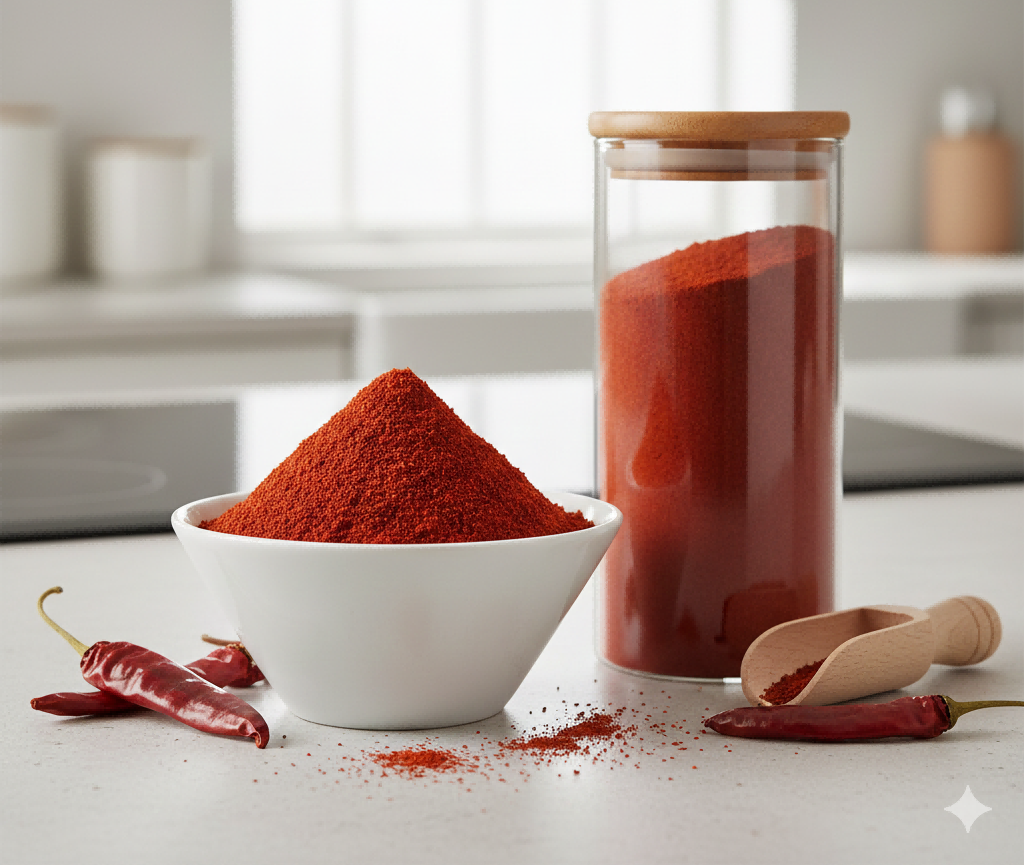
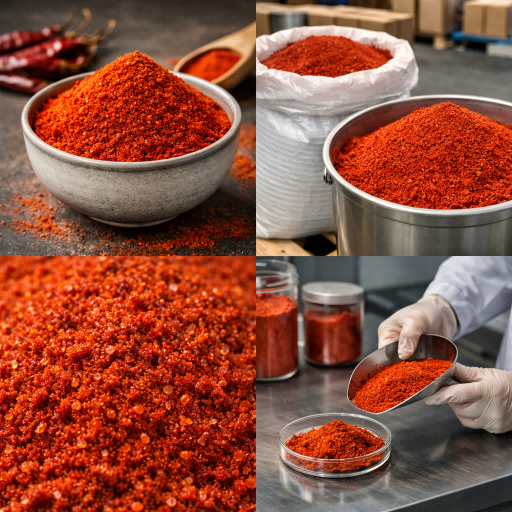
If you are sourcing chili powder for food manufacturing, seasoning blends, or foodservice distribution,
the most important question is not only price—it is whether the supplier can deliver stable color, stable heat, stable microbiology,
and stable compliance across batches. This guide breaks down the industrial chili powder manufacturing process
from raw chili selection to sterilization and packaging, and shows exactly what professional buyers should ask for.
industrial chili powder production
steam sterilization
ASTA color
SHU heat level
HACCP / ISO 22000
metal detection
export documentation
1) What Buyers Care About (Before Process Details)
Two chili powders can look similar but perform very differently in production.
For B2B procurement, the goal is predictability: you want the same red tone in every batch,
the same heat intensity in every formula, and the same safety and documentation every shipment.
In practice, buyers usually evaluate chili powder across four dimensions:
Stable ASTA color, SHU heat, aroma, and particle size across lots.
Microbiological control, sterilization validation, traceability, and metal detection.
COA per batch, allergen statements, pesticide residue and mycotoxin testing where required.
If the supplier cannot explain their process and QC, you will pay for it later—through rework, customer complaints, or recalls.
If you want a structured overview of how professional suppliers design process controls and specs,
you can also reference guidance from globally recognized food safety frameworks such as
Codex Alimentarius
and HACCP principles explained by the
U.S. FDA.
2) Step 1: Raw Chili Selection & Incoming Inspection
The industrial chili powder manufacturing process starts long before milling.
It begins with the raw chili itself. Different varieties produce different outcomes:
some deliver vivid red color, some deliver high pungency, and some are preferred for aroma.
A professional supplier usually builds a “raw material matrix” by origin, variety, harvest time, and drying method.
What to check at incoming inspection
- Visual sorting: color uniformity, mold risk, broken pods, foreign material.
- Moisture screening: too high increases mold and microbial risk; too low increases dust and losses.
- Contaminant risk: stones, stems, metal pieces, insect fragments—common in dried agricultural goods.
- Residue controls: pesticide residue risk depends on market and buyer requirements.
This single detail often predicts consistency.
3) Step 2: Cleaning, Sorting, and Foreign Matter Control
Cleaning is not glamorous, but it is where many quality problems are prevented.
Industrial lines typically use multiple layers of foreign matter removal:
air separation (to remove light impurities), screening, and sometimes gravity separation for stones.
The goal is not perfection at one step—it is progressive risk reduction.
A good supplier documents this as part of their HACCP plan: where foreign matter enters,
which equipment removes which risks, and how it is verified during production.
4) Step 3: Drying & Moisture Management
Even if raw chilies arrive dried, moisture can vary by batch and storage conditions.
Moisture management influences shelf life, microbiology, flowability, and even milling behavior.
Suppliers may condition material to a target range to improve downstream grinding stability.
Why moisture control matters
- Micro risk: higher moisture supports microbial growth and mold.
- Grinding stability: inconsistent moisture can cause uneven particle size or heating during milling.
- Clumping: moisture contributes to caking in storage and during transport.
5) Step 4: Destemming/Seed Control and Heat Profile Design
Buyers often assume “hotter chili” means “better chili,” but most food manufacturers actually want precision.
Heat profile is engineered by controlling stems and seeds (which influence harshness and bitterness),
and by blending varieties to hit a target SHU range.
| Target | How It’s Achieved | Where It Matters |
|---|---|---|
| Stable heat (SHU range) | Variety selection + blending + seed/stem control | Snack seasoning, sauces, instant noodles |
| Clean flavor (less harshness) | Better raw grading + controlled destemming | Premium blends, restaurant-grade products |
| Cost-effective intensity | Smart blend design instead of overusing hot varieties | Large-scale foodservice and OEM |
6) Step 5: Crushing & Milling (Particle Size / Mesh Control)
Milling is where chili becomes “chili powder,” and it is also where many suppliers accidentally damage quality.
Excessive heat during grinding can reduce aroma and darken color.
Professional lines use staged crushing and controlled milling to minimize thermal stress.
Key milling controls buyers should understand
- Target mesh size: fine powder for sauces and seasonings; coarse granules for toppings and visible texture.
- Temperature control: reduces aroma loss and prevents darkening.
- Dust management: affects yield, hygiene, and worker safety.
Suppliers who have an answer usually have better product stability.
7) Step 6: Blending & Standardization (Color, Heat, Flavor)
The heart of industrial chili powder production is standardization.
Dried agricultural raw materials naturally vary. A supplier’s job is to absorb that variation
and deliver a consistent output specification to your factory.
Standardization typically focuses on:
- Color: often described by ASTA or internal color targets.
- Heat: defined SHU range (or sensory target) depending on application.
- Particle size distribution: not just “fine vs coarse,” but how stable it is after shipping.
- Flavor balance: aroma, sweetness, bitterness, and roasted notes (depending on product type).
8) Step 7: Sterilization / Microbial Reduction
Spices are a known risk category for microbiology. Chili powder can carry elevated total plate counts
and potential pathogens if handled incorrectly. That is why many buyers require microbial reduction steps.
Common industrial methods include steam sterilization or validated heat treatment processes.
The key is validation: a serious supplier does not just “claim sterilization,” they can explain the method,
the target limits, and the verification approach.
Ask how the supplier balances both.
9) Step 8: Metal Detection, Sieving, and Final Safety Checks
After milling and blending, final safety checks typically include sieving for particle uniformity
and metal detection to reduce physical hazards. Depending on the supplier, this may also include magnets
at multiple points in the line.
If you are exporting or selling to strict retail channels, documentation around these controls matters.
A buyer should be able to receive:
- Metal detector sensitivity and verification records (on request)
- Batch traceability information
- COA with key specs and microbiology
10) Step 9: Packaging, Storage, and Shelf-Life Protection
Packaging is not a “last step”—it is a quality preservation system.
Chili powder is sensitive to moisture, oxygen, and light.
Poor packaging can cause color fading, aroma loss, and caking.
Packaging decisions that affect buyer outcomes
- Barrier materials: protect aroma and color.
- Batch coding: supports traceability.
- Storage guidance: temperature and humidity recommendations reduce complaints.
- Shipping format: bag size, pallet pattern, and container loading affect powder compaction and caking.
11) Quality Control: Specs, Testing, and Certificates
For many buyers, QC is the real product. The spice is only valuable if it meets your specification every time.
Below is a practical spec map that procurement teams commonly use when evaluating suppliers.
| Category | Typical Metrics | Why Buyers Care |
|---|---|---|
| Color | ASTA value (or internal color target) | Controls visual consistency in sauces, snacks, and retail products |
| Heat | SHU range or sensory panel target | Prevents batch-to-batch flavor drift and consumer complaints |
| Moisture | % moisture (target range) | Reduces caking, mold risk, and shelf-life issues |
| Microbiology | TPC, yeast/mold, coliforms; buyer-specific limits | Supports food safety and regulatory compliance |
| Contaminants | Foreign matter, heavy metals; mycotoxins if required | Protects brand risk in strict channels |
| Physical | Mesh size, particle distribution, flowability | Ensures smooth production and stable blending performance |
Note: Your exact testing panel depends on your market and end use (foodservice vs retail vs export).
A strong supplier will tailor the spec and documentation package to your channel.
12) Buyer Checklist: Questions to Ask Your Chili Powder Supplier
If your goal is to reduce sourcing risk and increase product consistency, use this checklist during supplier evaluation.
It’s designed for real procurement conversations, not marketing.
- Process: Can you explain your chili powder manufacturing process step-by-step?
- Raw material: How do you grade and inspect incoming chilies?
- Standardization: How do you control ASTA color and SHU heat across seasons?
- Sterilization: What microbial reduction method do you use, and how do you validate it?
- Traceability: Can you trace each batch back to raw lots and production date?
- Documentation: Do you provide COA, allergen statement, and compliance docs per shipment?
- Customization: Can you produce custom mesh sizes, heat levels, or blend profiles?
- Samples: Can you provide samples for lab tests and pilot runs?
The opposite is also often true.
13) Use Cases: Food Manufacturing, Foodservice, Retail
Food manufacturing
Manufacturers often prioritize tight specs and repeatability: stable color in sauce lines,
stable heat in snack seasonings, and particle size control for blending efficiency.
For these buyers, COA, traceability, and standardized batch performance are non-negotiable.
Foodservice and chain restaurants
Foodservice buyers care about consistent taste, predictable cost per portion, and operational ease.
Coarser chili (flakes or granules) may be preferred for toppings, while fine chili powder fits soups and sauces.
Retail and private label
Retail needs stable shelf life, attractive appearance, and clean documentation for compliance.
Packaging performance becomes part of quality—especially in humid climates and long-distance transport.
14) Request a Quote / Samples (RFQ)
Looking for a reliable chili powder supplier?
If you are sourcing for manufacturing, seasoning blends, or foodservice distribution, we can support you with:
- Custom specifications: mesh size, heat (SHU range), and color targets
- Food safety documentation: COA per batch, traceability, and compliance support
- Stable supply: consistent lots and standardized production controls
- Sampling for evaluation: samples for lab testing and pilot production
To request pricing and lead times, please include your target specification (mesh, heat, color), annual volume estimate,
destination market, and application (sauce, seasoning, instant noodles, etc.).
Contact us / Get an RFQ or browse our product range in the chili series.