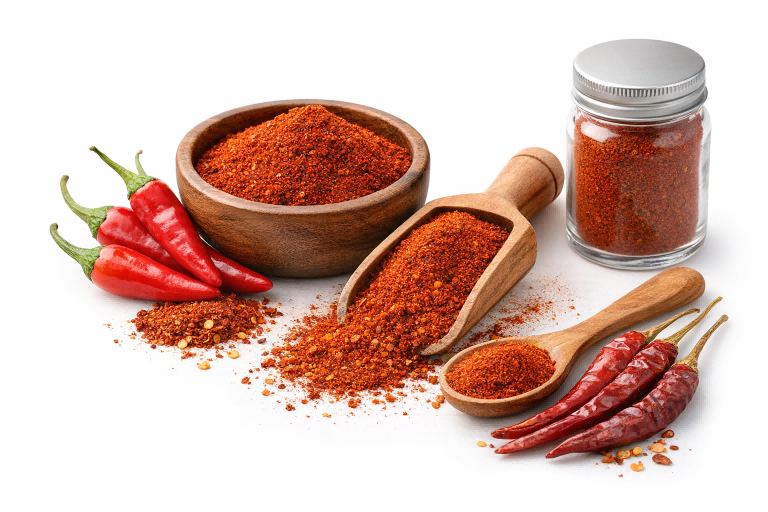
Built for importers, brand owners, and food manufacturers sourcing chili powder at scale.
Learn how to specify heat (SHU), color (ASTA), and mesh size, understand the most common
market types, and use a practical checklist to reduce risk in bulk procurement.
On this page
Who this guide is for
Procurement teams evaluating chili powder suppliers, defining specifications, and managing quality, compliance, and consistency across shipments.
Quick Specs Box (B2B Reference)
Use these ranges as a practical starting point for RFQs. Final specifications should be confirmed by grade, origin, and application, and verified by COA.
| Heat (SHU) | 1,000 – 50,000+ (mild to extra hot; can be standardized to target range) |
|---|---|
| Color (ASTA) | 40 – 180+ (higher ASTA generally indicates stronger red color strength) |
| Moisture | ≤ 10–12% (supports flowability and shelf stability) |
| Mesh size | 20–80 mesh common (fine powders typically 60–80 mesh) |
| Packaging | 1kg / 5kg / 10kg / 25kg; bulk bags with inner liner; retail packs available for OEM |
What to define in a professional RFQ
- Single-ingredient chili powder or blended chili powder seasoning
- Target SHU range and tolerance
- ASTA minimum requirement
- Mesh requirement (e.g., “80 mesh, 95% pass”)
- Destination market compliance requirements
- Packaging format and order volume
1) What Is Chili Powder?
Chili powder (also searched as chili powder spice or powder chili) is a ground spice product made from dried chili peppers.
In international trade, the term can refer to either:
- Single-ingredient chili powder: 100% ground dried chili pepper, used as a standardized ingredient for manufacturing.
- Chili powder seasoning blend: a recipe-driven spice mix that may include cumin, garlic, oregano, salt, paprika, and other spices.
Buyer note
To avoid confusion, specify “single-ingredient ground chili pepper” when you need a controlled ingredient, and specify the recipe when you need a blend.
2) Chili Powder vs Cayenne vs Ground Chili Pepper
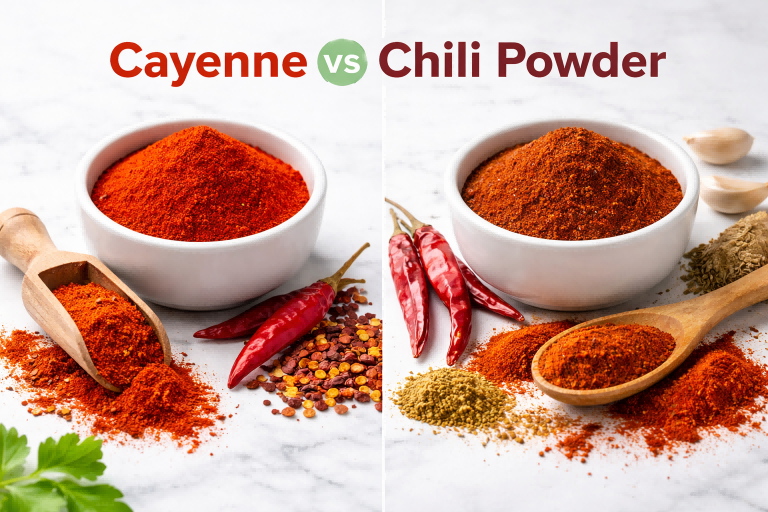
Chili powder vs cayenne
Cayenne usually refers to pepper-specific powder commonly associated with higher heat.
“Chili powder” can be mild or hot depending on the pepper variety, processing, or whether it is a blend.
Chili powder vs ground chili pepper
Ground chili pepper (or “ground chile”) typically indicates a single-ingredient product made only from dried chili peppers.
For B2B buyers, this term is often preferred because it reduces ambiguity.
Practical takeaway
- Formulation ingredient: choose single-ingredient ground chili pepper; define SHU/ASTA/mesh.
- Ready-to-use seasoning: choose a chili powder blend; define recipe, salt, allergens, and sensory profile.
3) Heat: SHU (Scoville) Explained for B2B Buyers
SHU (Scoville Heat Units) describes pungency driven by capsaicinoids. In industrial production, SHU affects dosage,
labeling, consumer tolerance, and batch-to-batch consistency.
Common heat tiers (guidance)
- Mild: ~1,000–5,000 SHU
- Medium: ~5,000–20,000 SHU
- Hot: ~20,000–50,000+ SHU
How to specify SHU in an RFQ
- Define a target range (e.g., 8,000–12,000 SHU).
- Request a recent COA with test method details.
- Set acceptance tolerance and re-test rules for incoming lots.
4) Color: ASTA and What It Means
ASTA color is widely used as an indicator of red color strength for paprika and chili powders.
For many applications, consistent color is as commercially important as heat.
Why ASTA matters
- Delivers consistent appearance in sauces, seasonings, meat products, and snacks
- Improves dosage economics when higher color strength is required
- Supports stable quality perception across batches
How to specify ASTA in an RFQ
- Set an ASTA minimum aligned to your product goal.
- Require COA on each lot and define acceptance tolerance.
- Confirm storage and packaging conditions to support color retention.
5) Mesh Size: Fine vs Coarse (and Why It Matters)
Mesh size describes particle size distribution and impacts flowability, dispersion, mouthfeel, and visible speckling.
In manufacturing, mesh specification is essential for repeatability.
Fine (60–80 mesh)
Smooth dispersion for sauces, soups, instant noodle seasonings, emulsions, and fine compound blends.
Medium (40–60 mesh)
Balanced performance for compound seasonings, marinades, and general-purpose blending.
Coarse (20–40 mesh)
Visible texture for rubs, toppings, and seasoning systems where speckling is desired.
Recommended RFQ wording
Example: “80 mesh, minimum 95% pass” or “40–60 mesh with defined coarse fraction.”
6) Common Types: Mexican / Indian / Japanese
“Chili powder” is not a single global standard. Buyers should align on culinary style, pepper variety, aroma profile, and whether the product is
a single-ingredient powder or a blended seasoning.
Mexican-style chili powder
Often linked to dried chile varieties and used as either single-variety powder or blended seasoning.
Commonly selected for aroma depth and balanced heat.
- Best for: tacos, chili bases, marinades, sauces
- Common specs: medium SHU, defined ASTA, mesh tailored to blending
Indian chili powder
Frequently specified by “color vs heat” needs. Buyers often require clearer compliance controls depending on destination market.
- Best for: curry bases, sauces, snacks, ready meals
- Common specs: ASTA minimum, SHU range, residue/contaminant limits
Japanese chili powder
May refer to pepper-only powders or seasoning blends (e.g., ichimi/shichimi styles). Clarify recipe and allergen controls for blends.
- Best for: ramen/soup seasonings, snacks, tabletop seasonings
- Common specs: recipe, fine mesh, strict allergen management
7) Use Cases: Products and Channels
Align SHU, ASTA, and mesh to the product matrix and processing conditions. Below are common B2B use cases.
Foodservice & Restaurants
- Rubs, marinades, taco seasoning systems, chili bases
- Preference: consistent flavor, easy dosing, stable heat
- Typical choice: 40–60 mesh, defined SHU range
Food Manufacturing
- Sauces, soups, instant noodles, compound seasonings
- Preference: uniform dispersion and batch repeatability
- Typical choice: 60–80 mesh, COA-controlled SHU/ASTA
Meat Processing
- Sausage, jerky, cured meats, marinades
- Preference: strong and stable color with controlled heat
- Typical choice: defined ASTA minimum, stable moisture
Snack Seasoning Systems
- Chips, extruded snacks, popcorn seasonings
- Preference: coating performance and flowability
- Typical choice: mesh tuned to your coating process
8) Buyer Checklist (COA / TDS / Audits / MOQ / Lead Time / Packaging)
COA: What to request for each batch
- Identity: product name, grade, origin, lot number
- Heat: SHU (method + result)
- Color: ASTA (method + result)
- Moisture: max limit
- Micro: TPC, yeast & mold, coliforms; E. coli / Salmonella as required
- Contaminants: heavy metals; residues per destination market requirements
- Aflatoxin: where required by your market or customer program
TDS / Specification sheet should include
- Ingredient statement (single-ingredient vs blend)
- SHU / ASTA ranges (with tolerances)
- Mesh distribution requirements
- Packaging format and net weights
- Shelf life and storage conditions
- Allergen statement (especially for blends)
- Compliance declarations for your destination market
Audit & verification essentials
- Food safety system (ISO / HACCP or equivalent)
- Traceability (raw material lot to finished batch records)
- Foreign body control (sieving, metal detection, sanitation)
- Sampling plan and retention policy
- Consistency program (ability to standardize to target SHU/ASTA)
MOQ & lead time (commercial guidance)
- MOQ: depends on grade, customization, and packaging; negotiable for repeat programs
- Lead time: varies by stock, production schedule, and QC release
- Packaging: choose moisture/oxygen protection appropriate to your market and transit time
9) FAQ
Is chili powder the same as cayenne pepper?
Not always. Cayenne usually refers to a hotter pepper-specific powder. “Chili powder” may be a single-ingredient ground chili pepper or a blended seasoning.
For B2B sourcing, specify product type and define SHU/ASTA/mesh.
What does ASTA mean for chili powder quality?
ASTA indicates red color strength. Buyers often set an ASTA minimum to achieve stable appearance in finished products and verify it on each batch COA.
What SHU range should I request for manufacturing?
Choose SHU based on your target heat and dosage. Many manufacturers request a defined SHU range to reduce variation across harvest seasons and shipments.
What mesh size is best for sauces and seasonings?
Fine mesh (commonly 60–80) helps even dispersion in sauces and compound seasonings. Coarser mesh is often selected for rubs and visible speckling.
Can chili powder be customized for OEM or private label?
Yes. Common customization includes target SHU, ASTA, mesh distribution, recipe (for blends), and packaging format for foodservice or retail.
What should I request before placing a bulk order?
Request a TDS/spec sheet, recent batch COA, certifications, allergen statement (for blends), and compliance declarations required by your destination market.
10) Request a Quote / Sample / TDS
Get a Quote
Share your target SHU, ASTA, mesh, moisture limit, packaging format, destination country, and expected volume for an accurate quotation.
RFQ Template (copy & paste)
We are sourcing chili powder (single-ingredient / blend). Target heat: ____ SHU. Target color: ASTA ____ (min).
Mesh: ____ (e.g., 80 mesh, 95% pass). Moisture: ____ (max). Packaging: ____ (e.g., 25kg bag with liner).
Destination: _____. Please provide COA, TDS, certifications, MOQ, lead time, and sample options.