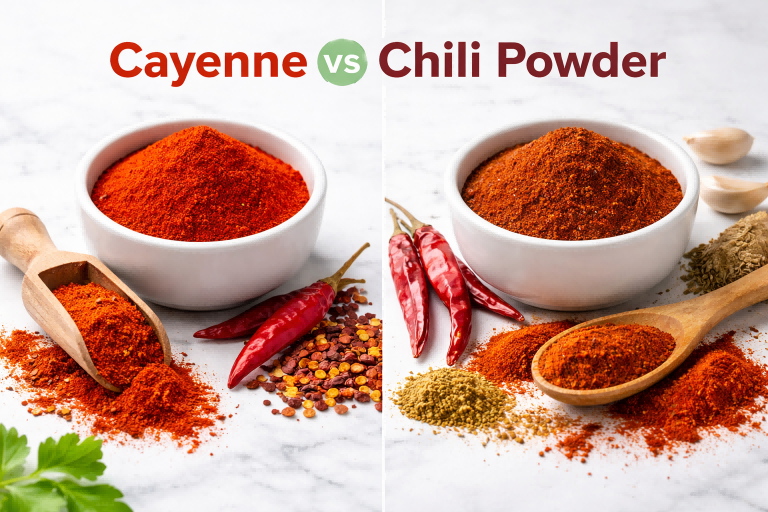
Cayenne vs chili powder is not just a kitchen comparison—it is a sourcing and specification decision that impacts heat consistency (SHU),
finished color (ASTA), labeling, and cost for manufacturers, brand owners, and co-packers.
This guide shows how to define each ingredient correctly and how to write an RFQ that gets apples-to-apples quotes.
For a complete chili powder framework (types by region, heat tiers, color grades, mesh selection, and procurement checklist),
reference our pillar page:
Chili Powder: The Complete B2B Guide.
Quick Specs Box (Buyer-Friendly Reference)
Fast clarity (what most B2B buyers need to know)
- Cayenne pepper typically refers to a hot pepper powder used to raise SHU efficiently.
- Chili powder can mean single-ingredient ground chili pepper or a chili powder spice blend (common in North America).
- cayenne v chili powder appears in searches; treat it as the same comparison and standardize to measurable specs.
If you are sourcing multiple chili powder types (Mexican/Indian/Japanese) or building a heat/color tier system, see:
Chili Powder B2B Guide.
Typical starting ranges (set final specs per SKU)
| Heat (SHU) | Cayenne: often 20,000–50,000+; Chili powder: mild to hot (define the range) |
|---|---|
| Color (ASTA) | Varies by pepper & process; set ASTA minimum if appearance matters |
| Moisture | Typically ≤ 10–12% |
| Mesh | 20–80 mesh common; specify “% pass” for consistency (e.g., 95% through 60 mesh) |
| Packaging | 1kg / 5kg / 10kg / 25kg bags with inner liner; OEM options available |
Cayenne vs Chili Powder: Side-by-Side Comparison
The biggest sourcing risk is buying by name. Use this table to translate “cayenne and chili powder” into clear procurement categories.
| What it usually is | Cayenne: single-ingredient hot pepper powder (heat-focused) |
|---|---|
| What “chili powder” can mean | Chili powder: either single-ingredient ground chili pepper or a chili powder spice blend (cumin/garlic/oregano/salt, etc.) |
| Primary buying KPI | Cayenne: SHU range and variance control · Chili powder: aroma + ASTA + SHU + mesh (depending on type) |
| Labeling implications | Blend risk: “chili powder spice” requires full ingredient declaration, allergen statement, and change control |
| Best fit (typical) | Cayenne: heat adjustment and standardization · Chili powder: base color/aroma and regional profiles |
Specs That Control Performance (SHU, ASTA, Mesh)
SHU (heat): buy a range, not a word
In cayenne vs chili powder, the question “which is hotter?” is only useful when you define SHU.
For production stability, set a target SHU range (with tolerance) and require SHU reporting per lot.
- Specify: target SHU range + acceptance tolerance
- Agree: sampling method and reporting frequency on COA
- Plan: standardization (blending) if you need low variance across seasons
ASTA (color): protect finished appearance
ASTA directly affects the visual outcome in sauces, rubs, snack seasonings, and meat systems.
If color is brand-critical, set an ASTA minimum and confirm it on the COA.
- High-impact: sauces, snack dusting, processed meats, spice blends
- Procurement control: ASTA minimum + storage guidance
- QA control: define acceptance criteria and re-test triggers
Mesh (particle size): processing consistency
Mesh affects dispersion, mouthfeel, dusting behavior, and speckling. Even with similar SHU, different mesh can change how the powder performs.
- 60–80 mesh: smoother dispersion for sauces and fine blends
- 40–60 mesh: general blending, rub systems
- 20–40 mesh: visible texture/speckling
Best practice: specify mesh as “screen size + % pass” to reduce variability.
If you buy “cayenne pepper chili powder”
“cayenne pepper chili powder” is often a search phrase, not a specification. Confirm whether it means:
(1) single-ingredient cayenne powder, or (2) a chili powder blend containing cayenne.
- Require ingredient declaration (for blends)
- Define SHU, ASTA, and mesh in the RFQ
- Set change-control rules (no ingredient swaps without notice)
Need deeper chili powder selection (types by region and use)?
Use the pillar page for Mexican/Indian/Japanese types, heat tiers, color grades, mesh guidance, and procurement checklist:
Chili Powder: The Complete B2B Guide.
Use Cases (Products & Channels)
Where cayenne performs best
- Hot sauces and heat adjustment programs
- Snack seasoning where SHU must be consistent across lots
- Meat processing and rub systems requiring precise heat control
- Co-manufacturing where formula repeatability is critical
Buyer goal: hit target SHU with minimal dosage variance.
Where chili powder performs best
- Complex flavor + color base for sauces and dips
- Compound seasonings (dry blends)
- Meat rubs and marinades needing aroma + appearance
- Regional profiles (when you need a specific taste direction)
Buyer goal: balance aroma, ASTA, SHU, and cost.
Use chili powder for base aroma/color, then add cayenne to fine-tune SHU. Many buyers prefer this to reduce seasonal volatility and improve lot-to-lot consistency.
Buyer Checklist (COA, Testing, Factory Audit)
COA must-haves (per lot)
- Lot number, origin, production date, traceability
- SHU (heat)
- ASTA (when color matters)
- Moisture
- Micro specs aligned to your QA program
Testing & risk controls
- Incoming inspection: visual + sensory (off-notes)
- Verification plan: SHU/ASTA spot checks by risk tier
- Retention sample per lot for traceability
- Change control for blends (ingredient substitutions)
process hygiene, foreign matter controls, lot segregation, QA release procedures, and traceability documentation.
MOQ & Lead Time (What to Put in Your RFQ)
MOQ guidance
- Depends on grade, customization (SHU/ASTA/mesh), and packaging
- Repeat programs are typically negotiable
- For trials: request a sample + a pilot-friendly MOQ option
Lead time guidance
- Depends on stock status and QC release cycle
- Confirm timeline for sample approval, production, and inspection
- Ask for the earliest ship window and a realistic ETA range
FAQ
Is cayenne vs chili powder the same as “cayenne v chili powder”?
Yes. “Cayenne v chili powder” is a common shorthand variation. For procurement, treat both as the same comparison and standardize the RFQ by SHU, ASTA, and mesh.
Can I use cayenne and chili powder together in manufacturing?
Yes. Many manufacturers use chili powder for aroma and color, then add cayenne to reach a precise SHU target. This improves consistency when raw material heat varies by season.
What does “cayenne pepper chili powder” mean in B2B sourcing?
It is often a search phrase. Confirm whether the supplier is offering single-ingredient cayenne powder or a chili powder blend containing cayenne, then specify SHU/ASTA/mesh.
Get a Quote / Request a Sample / Download TDS
Send this RFQ to get comparable quotes
- Product: cayenne pepper or chili powder (single-ingredient or blend)
- Target heat: ____ SHU (range) + tolerance
- Target color: ____ ASTA (minimum, if required)
- Mesh: ____ (screen size + % pass)
- Moisture: ____ (max), packaging, destination country
- Order quantity (trial + annual volume estimate)
Copy-paste RFQ template
We are sourcing cayenne vs chili powder for (application). Product needed: (cayenne / chili powder, single ingredient / blend).
SHU: ____ (range) with tolerance. ASTA: ____ (min). Mesh: ____ (% pass). Moisture: ____ (max).
Packaging: _____. Destination: _____. Please provide COA, TDS, certifications, MOQ, lead time, and sample options.
If your project requires selecting among multiple chili powder types and specs, use:
Chili Powder: The Complete B2B Guide.
“`