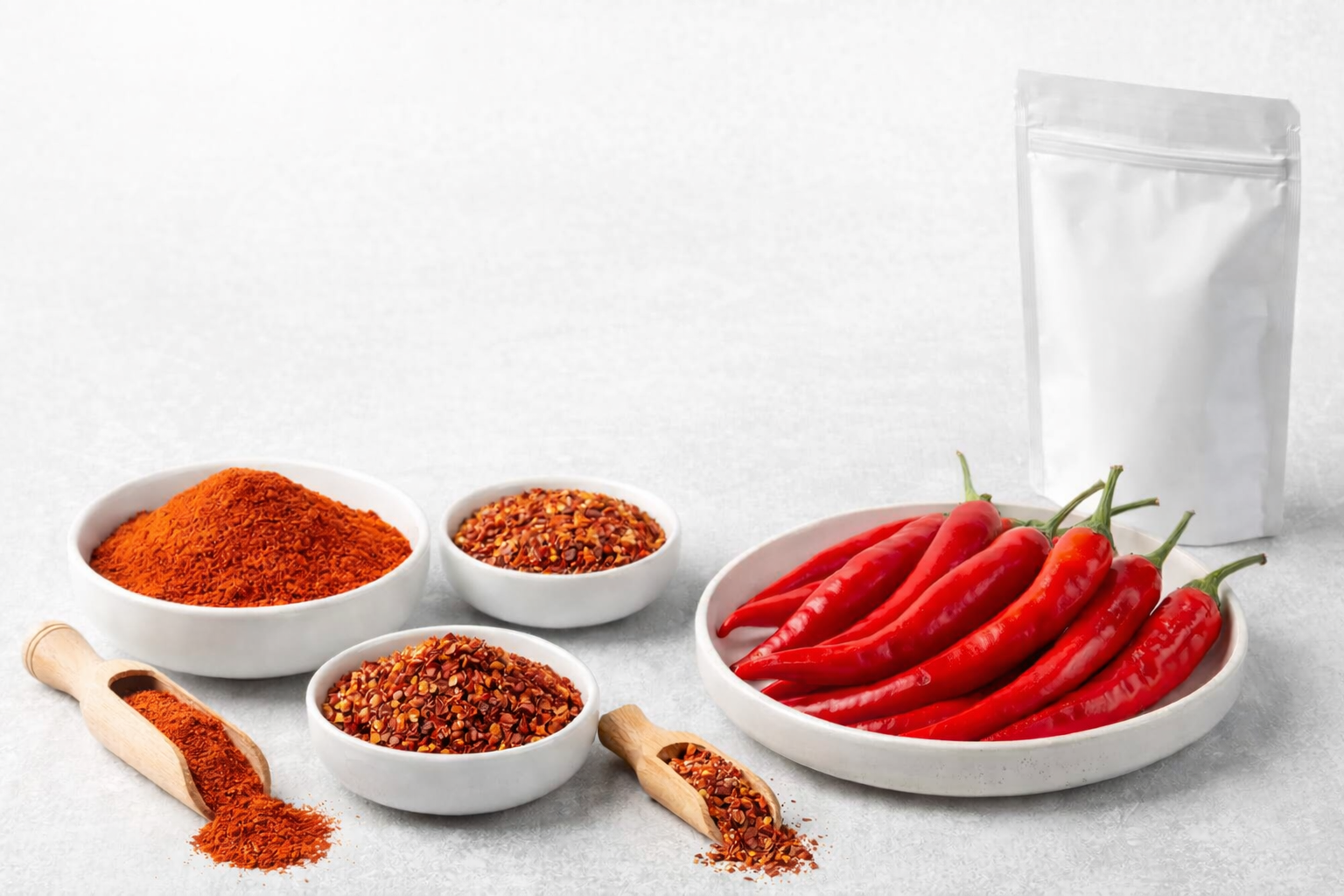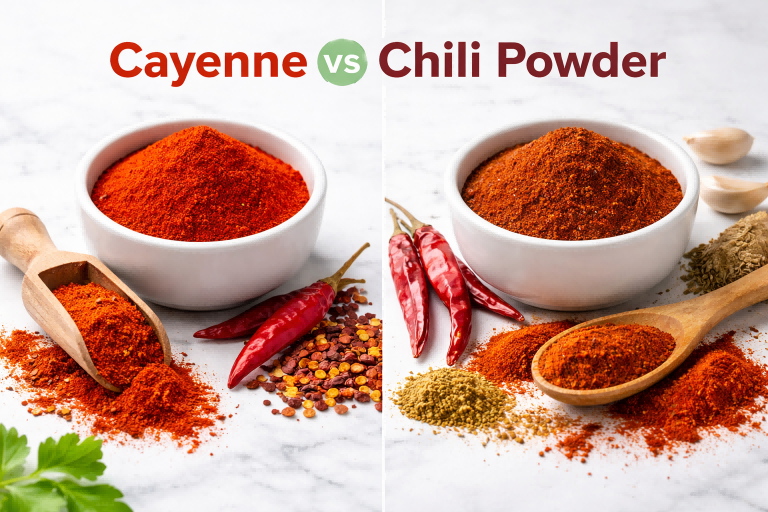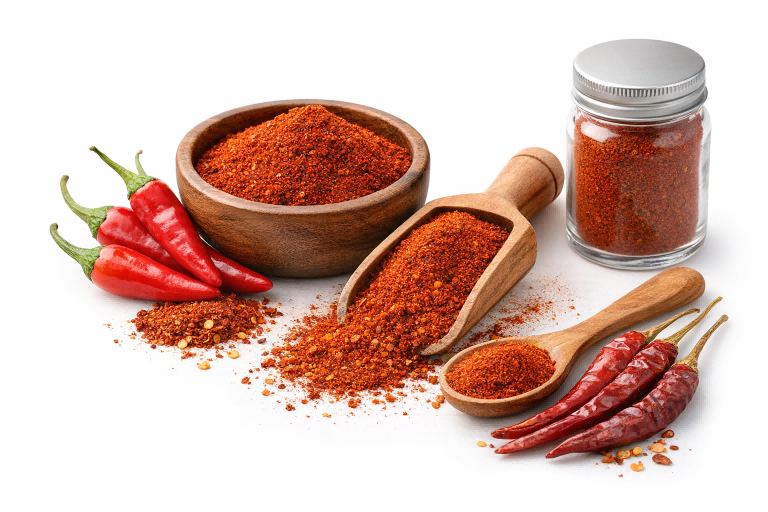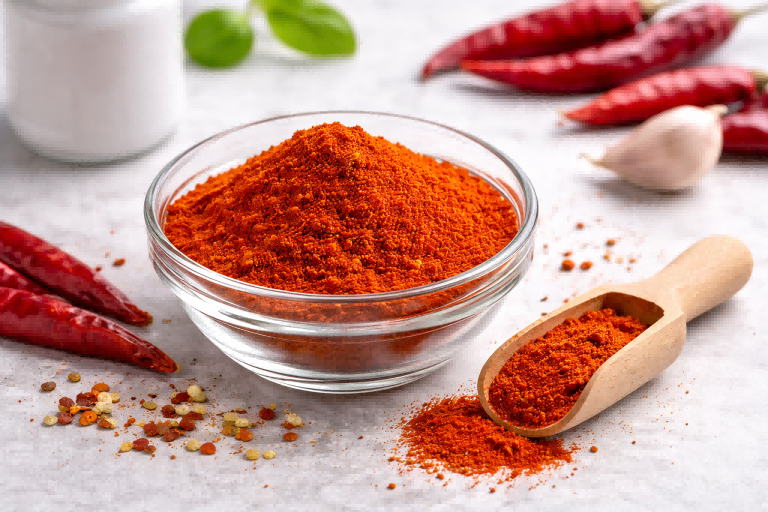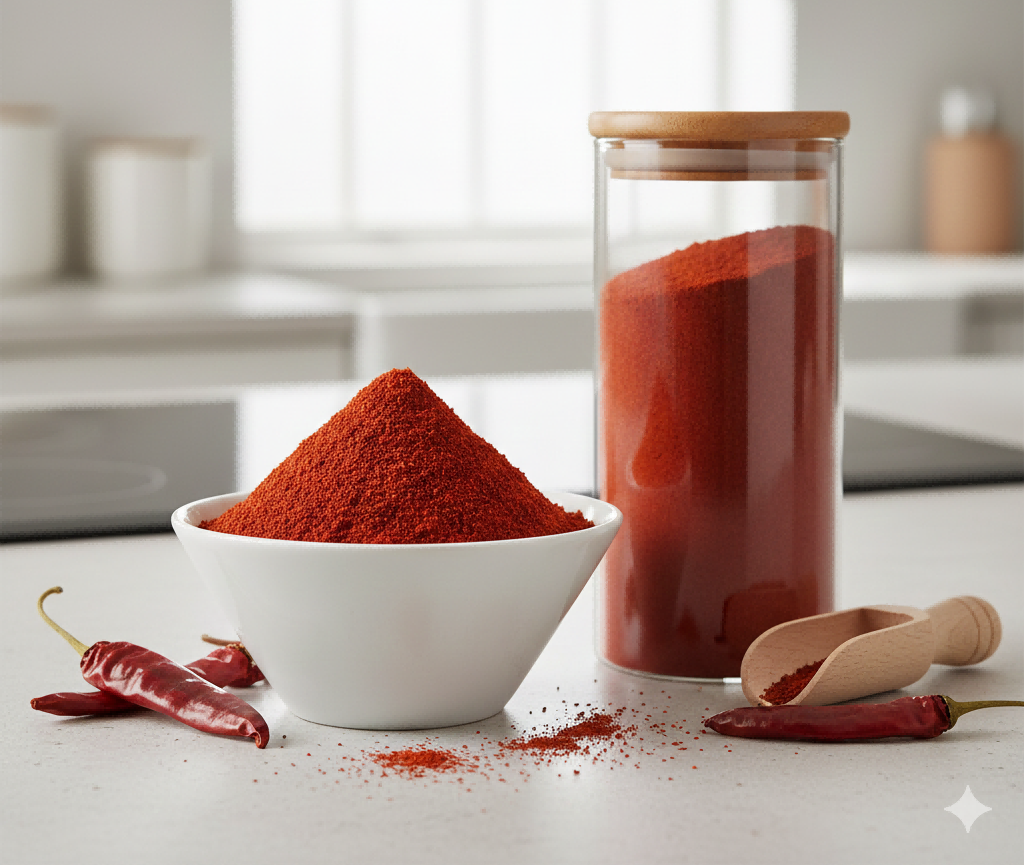
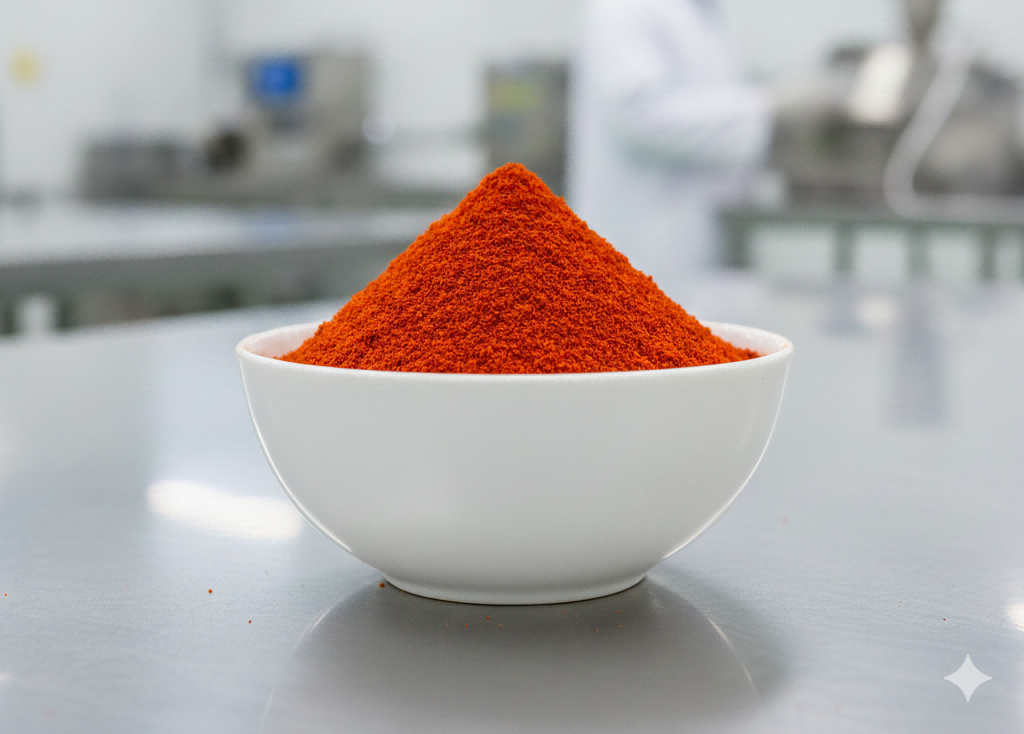
Chili powder (also called chili pepper powder) looks simple—dried chili, ground into powder—but consistent industrial quality is never “simple.”
In export and foodservice supply chains, buyers want reliable heat level, stable color, clean aroma, controlled moisture, and documented food safety.
This guide breaks down the full chili powder production flow—from raw chili selection to cleaning, drying, milling, sterilization, packaging, and
quality control—so procurement and QA teams can evaluate suppliers with confidence.
industrial chili powder production
chili powder quality control
ASTA color
SHU heat level
steam sterilization
metal detection
Executive Summary (1–2 minutes)
Industrial chili powder manufacturing is a controlled sequence of steps designed to protect flavor and color while managing food safety risks.
The process generally follows: raw chili sourcing → cleaning/sorting → drying → de-stemming/de-seeding → grinding → sieving/blending
→ sterilization (optional but common for export) → metal detection → packaging → QC release.
across seasons, batches, and markets, with measurable specifications (color, heat, moisture, micro limits, contaminants, and foreign matter control).
Table of Contents
- Scope: What This Guide Covers (and Common Definitions)
- Step 1 — Raw Material Selection: Chili Varieties and Supplier Inputs
- Step 2 — Pre-Processing: Cleaning, Sorting, and Defect Removal
- Step 3 — Drying Technology: Sun Drying vs Hot-Air Drying vs Controlled Systems
- Step 4 — De-stemming & De-seeding: Managing Heat, Flavor, and Yield
- Step 5 — Grinding/Milling: Particle Size, Heat Management, and Aroma Protection
- Step 6 — Sieving & Blending: Mesh Size, Uniformity, and SKU Standardization
- Step 7 — Microbial Control: Sterilization Options and Validation
- Step 8 — Foreign Matter Control: Magnets, Sieves, Metal Detection
- Step 9 — Packaging: Shelf Life, Moisture Barrier, and Transport Stability
- Quality Control Plan: Specs, Sampling, and Release Criteria
- B2B Buyer Checklist: How to Evaluate a Chili Powder Supplier
- Product Applications: Foodservice, Seasoning, and Industrial Blends
- FAQ
1) Scope: What This Guide Covers (and Common Definitions)
This article focuses on industrial chili powder used in food manufacturing, foodservice, and seasoning production.
In real supply chains, chili powder can refer to different products:
- Chili powder (pure): ground dried chili pepper with no added salt, sugar, or other spices.
- Chili flakes/crushed chili: larger particle sizes for toppings and visible texture.
- Paprika (sweet pepper powder): typically lower heat, used for color and mild pepper flavor.
- Compound chili seasoning: chili + salt/spices/MSG/sugar or customized blends for specific cuisines.
Throughout the manufacturing process, the supplier must control variables that directly affect customer acceptance:
heat level (SHU), color value (often referenced by ASTA), aroma, moisture, particle size distribution, and safety indicators
(microbial limits, aflatoxin risk, pesticide residues, heavy metals, foreign matter).
safely, and documentably.”
If you want an extended sourcing perspective beyond manufacturing steps—like how buyers compare suppliers, documentation expectations, and
procurement strategies—you can also read this internal industry resource:
Chili Powder Supplier Industry Guide
.
It pairs well with this process-focused article for building a complete SEO content cluster.
2) Step 1 — Raw Material Selection: Chili Varieties and Supplier Inputs
Raw chili selection is the single largest driver of final product performance. No downstream process can fully “fix” poor raw materials.
2.1 Variety selection: heat, color, aroma, and cost
Chili varieties differ dramatically in capsaicinoid content (heat), pigment profile (red intensity), skin thickness, and aroma.
Industrial producers typically develop a variety strategy that matches target SKUs:
- High-heat chili powder: strong pungency, used in hot sauces, spicy seasonings, and hot pot/BBQ blends.
- Color-focused chili powder: vivid red appearance for visual impact in snacks, sauces, and sausage systems.
- Balanced chili powder: medium heat + red color for general seasoning applications.
2.2 Raw material acceptance: what to check before processing
Before production starts, professional plants check raw chili for a combination of visual defects and measurable risk factors:
- Moisture level: high moisture increases mold risk and reduces shelf stability.
- Foreign matter: stones, stems, plastics, threads—risk for both safety and customer complaints.
- Mold and insect damage: can create off-flavor and microbial risk; also associated with aflatoxin risk.
- Color distribution: uneven maturity affects color consistency batch-to-batch.
Strong suppliers build multi-origin sourcing and blending strategies to stabilize output across seasons.
2.3 Traceability and supplier documentation
For industrial buyers, traceability matters. Even when specifications are met, supply chains need documentation:
farm/region origin, harvest period, storage method, and test reports. If you buy for export markets, you may also require
pesticide residue testing, heavy metal testing, and microbial limits aligned with your target region’s requirements.
3) Step 2 — Pre-Processing: Cleaning, Sorting, and Defect Removal
Pre-processing is where industrial plants separate “food-grade chili” from “risk.” Many quality failures start here:
inadequate cleaning leads to foreign matter complaints; poor sorting leads to inconsistent color; missed moldy chilies lead to micro failures.
3.1 Typical cleaning steps in an industrial line
- Vibratory screening: removes dust and small debris.
- Air aspiration: separates light impurities like leaf fragments.
- Manual or optical sorting: removes moldy, blackened, or damaged pods.
- Magnet pre-check: early-stage magnets capture ferrous fragments from upstream handling.
3.2 Why sorting matters for color and taste
Chili color is not “only a pigment issue.” Color is a proxy for maturity and oxidation state. Over-dried or oxidized chili can contribute a brown hue,
while under-ripe chili can appear pale. These differences affect both appearance and flavor.
Sorting and blending strategies help ensure that the finished powder stays within customer-defined color ranges.
4) Step 3 — Drying Technology: Sun Drying vs Hot-Air Drying vs Controlled Systems
Drying is the “stability gate.” If moisture is not controlled, you cannot reliably control microbial risk, shelf life, or milling efficiency.
4.1 Drying objectives in industrial chili powder production
- Reduce moisture to a stable range: helps prevent mold growth and caking.
- Protect color: excessive heat or prolonged oxidation can reduce red intensity.
- Protect aroma: overly hot drying can drive off desirable volatile compounds.
4.2 Common drying approaches
| Drying method | Pros | Risks / limitations | Best use cases |
|---|---|---|---|
| Sun drying (traditional) | Low cost, widely available | Weather variability, contamination risk, inconsistent moisture | Local markets, non-critical applications (with strong sorting) |
| Hot-air drying | Higher consistency, scalable | Overheating can dull color/aroma if not controlled | Industrial lines, export-oriented programs |
| Controlled low-temperature drying | Better aroma/color retention | Higher energy cost; needs process tuning | Premium SKUs, high color / high aroma products |
Under-drying increases microbial risk and causes milling clogs. The target is controlled, not extreme.
4.3 Moisture control and storage after drying
After drying, chilies must be protected from re-absorbing moisture. Industrial operations typically use
sealed bins, humidity control in storage areas, and FIFO rotation to prevent quality drift.
5) Step 4 — De-stemming & De-seeding: Managing Heat, Flavor, and Yield
Many buyers underestimate how much the stem and seed ratio changes the product.
Seeds can contribute bitterness and a different “spike” of heat perception. Stems generally contribute little desirable flavor and can reduce color.
Industrial plants remove stems and adjust seed ratio depending on product positioning.
5.1 Why de-stemming is a quality decision
- Improves color purity: fewer brown/woody particles.
- Improves texture: reduced fiber content, cleaner mouthfeel in sauces.
- Reduces foreign matter complaints: stems are visually obvious in fine powders.
5.2 Seed strategy: not “remove all” vs “keep all”
Seed level is a formulation lever. Some culinary cultures expect seed specks; others prefer smooth red powder.
From an industrial standpoint, the right approach is to define seed ratio as part of the SKU spec:
- Low seed: cleaner taste, better color; often used in sauces and snack seasonings.
- Medium seed: balanced, cost-efficient general-purpose powder.
- High seed / visible seed: specific regional products, coarse chili blends.
6) Step 5 — Grinding/Milling: Particle Size, Heat Management, and Aroma Protection
Milling turns dried chili into a finished ingredient—but it also creates heat through friction. Heat is the enemy of aroma and color stability.
6.1 Milling goals
- Achieve target particle size distribution (fine powder, coarse powder, flakes).
- Minimize temperature rise to protect volatile aromatics and color pigments.
- Maintain uniformity for consistent dosing and blending performance.
6.2 Common industrial milling systems
Plants may use hammer mills, pin mills, or other systems depending on desired fineness and throughput.
Regardless of equipment, the same principles apply:
- Controlled feed rate: prevents overheating and inconsistent grind.
- Staged grinding: coarse pre-grind followed by fine grind improves uniformity.
- Temperature monitoring: especially important for high color-value products.
6.3 Why particle size changes customer experience
Particle size is not only a technical detail. It affects:
- Color release: finer particles disperse faster in sauces.
- Heat release: finer particles can feel “hotter” due to faster capsaicin release.
- Flowability and caking: ultra-fines absorb moisture and oxidize more easily.
- Appearance: coarse chili gives visible texture; fine chili creates uniform red soups.
For example: “should disperse within 30 seconds in 60°C water with no visible specks,” or “target for snack seasoning adhesion.”
7) Step 6 — Sieving & Blending: Mesh Size, Uniformity, and SKU Standardization
After grinding, plants sieve the powder to remove oversize particles and control uniformity.
This step is also where many manufacturers create multiple SKUs from the same base material:
fine powder, medium granulation, coarse flakes, and tailored blends.
7.1 Sieving: turning “ground chili” into a spec-driven product
Sieving ensures that the delivered product behaves consistently in your production line:
consistent flow into hoppers, consistent mixing, and consistent sensory output.
For buyers, sieving is a sign of process maturity—suppliers who skip this step often struggle with batch-to-batch variance.
7.2 Blending: stabilizing heat and color across seasons
Chili is an agricultural product. Heat and color naturally drift by harvest and region.
Professional manufacturers build blending programs using:
- Heat balancing: blending high-heat and mild material to hit a target SHU.
- Color balancing: blending high color-value material with stable base to meet visual targets.
- Aroma balancing: adjusting pepper notes to fit customer expectations.
If you are selecting from a supplier’s product portfolio (fine powder, coarse powder, flakes, paprika-type powders, customized blends),
you can browse a structured range here:
Chili Series Products
.
This kind of category page also helps your internal teams align product selection with application needs.
8) Step 7 — Microbial Control: Sterilization Options and Validation
Spices and dried chili products carry inherent microbial risk because they are grown outdoors and can be exposed during drying and storage.
Many industrial buyers—especially for export, ready-to-eat foods, and seasoning blends—require a microbial reduction step.
8.1 Common microbial control approaches
- Steam sterilization: a widely used method to reduce microbial load; must be validated to avoid quality damage.
- Dry heat / thermal treatment: can reduce micro load but may impact color/aroma if not tuned.
- High standards in upstream control: strong cleaning, controlled drying, hygienic milling to minimize initial load.
8.2 What buyers should ask for
Sterilization is not a checkbox; it must be validated. Buyers commonly request:
- Microbial test results (TPC, yeast/mold, coliforms, pathogen absence if required).
- Process description and validation approach (how the supplier ensures consistent reduction).
- Post-treatment handling SOP (to prevent re-contamination).
The best suppliers tune the reduction step to meet your limits while preserving sensory performance.
9) Step 8 — Foreign Matter Control: Magnets, Sieves, Metal Detection
Foreign matter control is non-negotiable in industrial supply chains. Complaints about metal, stones, or plastic contamination can shut down a customer’s line
and trigger recalls. Strong suppliers build multiple layers of defense.
9.1 Layered foreign matter control strategy
- Pre-cleaning screens and aspiration to remove large debris and dust.
- Magnets to capture ferrous fragments from equipment or upstream handling.
- Sieving to remove oversize particles and non-chili fragments.
- Metal detection on final packed product to capture remaining metallic contaminants.
9.2 What buyers should verify
Ask your supplier how they validate their metal detector (test pieces, frequency, calibration records),
and where it sits in the line (ideally after sterilization and before final carton sealing).
The supplier must prove it is working and routinely verified.
10) Step 9 — Packaging: Shelf Life, Moisture Barrier, and Transport Stability
Packaging is not a marketing detail in B2B—it is a quality control tool. Chili powder degrades through oxygen exposure, moisture uptake, and light.
10.1 Packaging objectives
- Moisture barrier: prevents clumping and microbial risk.
- Oxygen barrier: protects aroma and color from oxidation.
- Practical handling: supports warehouse stacking, re-sealing, and production line feeding.
10.2 Typical industrial packaging formats
- Bulk bags for food factories (consistent lot handling, lower packaging cost).
- Smaller bags for foodservice and distribution (reduces open-pack quality loss).
- OEM retail packaging for private label programs (requires additional compliance and labeling).
“stale aroma” complaints—even when the powder was excellent at shipment.
10.3 Storage and transport considerations
Chili powder should be stored cool and dry. Avoid direct sunlight and high humidity zones. During transport,
temperature and humidity spikes can accelerate caking and color loss. Buyers often include storage requirements in supplier agreements to align expectations.
11) Quality Control Plan: Specs, Sampling, and Release Criteria
Quality control turns a “spice” into an industrial ingredient. A strong QC plan aligns three things:
customer requirements, measurable parameters, and operational reality.
11.1 Core specifications buyers commonly define
| Specification category | Examples | Why it matters |
|---|---|---|
| Heat level | Target SHU range; capsaicin-based targets | Controls consumer experience and product consistency |
| Color | ASTA color range (where used); visual reference standard | Direct impact on appearance in sauces, snacks, soups |
| Moisture | Moisture % limit | Prevents caking and reduces microbial risk |
| Particle size | Mesh / PSD target; fines limit | Controls dispersion, flowability, and mouthfeel |
| Microbiology | TPC, yeast/mold, coliforms; pathogen absence if required | Food safety and export compliance |
| Contaminants | Aflatoxin, pesticide residues, heavy metals | Regulatory compliance and brand protection |
| Foreign matter | Metal detector validation; visual foreign matter limit | Prevents line shutdowns and complaints |
11.2 Sampling and batch release: what good looks like
In professional supply chains, batch release is not only lab testing—it includes process checks and documentation.
A mature supplier typically supports:
- Batch COA: key parameters with traceability (lot number, production date).
- Retained samples: for dispute resolution and shelf-life tracking.
- Corrective action flow: how non-conforming lots are handled.
A “spec-driven relationship” is the foundation of stable long-term purchasing.
11.3 Sensory QC: the missing link
Some buyers rely only on lab numbers. That is a mistake. Two powders can have similar SHU but taste very different due to aroma, seed ratio,
drying style, or oxidation. Add a simple sensory protocol:
- Color check on white paper under consistent lighting.
- Aroma check (freshness, any musty notes).
- Hot water dispersion test (for clumping and color release).
- Application test (in your real product matrix: oil, sauce, soup, or seasoning).
12) B2B Buyer Checklist: How to Evaluate a Chili Powder Supplier
Use this checklist to compare suppliers quickly and reduce procurement risk. It is designed for buyers sourcing chili powder for export,
industrial seasoning, or foodservice.
12.1 Supplier capability checklist
- Raw material strategy: multi-origin sourcing and blending capability to stabilize seasonal drift.
- Cleaning and sorting: documented steps and defect removal standard.
- Milling control: temperature management and consistent particle size distribution.
- Microbial control: validated treatment process (when required) and post-treatment hygiene SOP.
- Foreign matter control: magnets + sieving + metal detection validation records.
- Documentation: COA, traceability, allergen statement, and compliance test ability.
- Packaging options: moisture/oxygen barrier solutions, various pack sizes, re-seal options.
12.2 Questions that reveal supplier maturity
- How do you keep SHU stable across different harvest seasons?
- How do you control moisture re-absorption after drying?
- What is your standard metal detector verification procedure?
- How do you prevent re-contamination after microbial reduction?
- Can you provide retained samples and COAs for each lot?
A supplier who can consistently hit tighter specs is often a safer long-term partner—even if the unit price is slightly higher.
13) Product Applications: Foodservice, Seasoning, and Industrial Blends
Chili powder is a base ingredient across many categories. Buyers should specify requirements based on the application because “one chili powder” rarely fits all.
13.1 Foodservice use cases
- Hot pot and soup bases: need fast color release and clean aroma; excessive fines may make broth look muddy.
- BBQ rubs and marinades: require consistent heat and good adhesion to meat.
- Table chili / dipping: often prefers coarser grind and visible texture; seed strategy matters.
13.2 Industrial manufacturing use cases
- Snack seasoning: needs uniform particle size for adhesion; color must be stable during storage.
- Sausage and processed meats: often uses chili/paprika for color; micro limits may be strict.
- Sauces and condiments: needs smooth dispersion and minimal bitterness; consistent heat is critical.
13.3 How to choose the right chili powder SKU
The most practical approach is to map your application to a SKU family (fine, medium, coarse, flakes, paprika-type) and then tighten specs.
If you are building a multi-SKU program, keeping all chili SKUs under one coherent supplier system can simplify documentation and traceability.
FAQ
What is the most important step in chili powder manufacturing?
Raw material selection and drying control usually have the largest impact. Poor raw chili and uncontrolled drying create defects that cannot be fully corrected
by milling or blending later.
Why does chili powder sometimes cake or form lumps?
Caking is typically driven by moisture uptake (humidity exposure), excessive fines, and insufficient moisture-barrier packaging. Storage conditions after opening
also matter. Smaller pack sizes and better resealing often solve this problem.
How do suppliers keep heat level consistent?
Professional suppliers blend different raw materials to hit a target SHU range, and they validate with routine testing. Without blending and testing,
seasonal variability can cause big swings in heat perception.
Do all chili powders require sterilization?
Not always. Requirements depend on your application, target market, and microbial limits. Many export and ready-to-eat programs require validated microbial
reduction, while some cooking applications rely on sufficient downstream kill steps.
What documents should I ask for as a B2B buyer?
Common documents include a batch COA, ingredient statement, allergen declaration, traceability information, microbial reports, contaminant test ability
(aflatoxin/pesticides/heavy metals depending on market), and packaging/storage instructions.
Back to top: ↑